
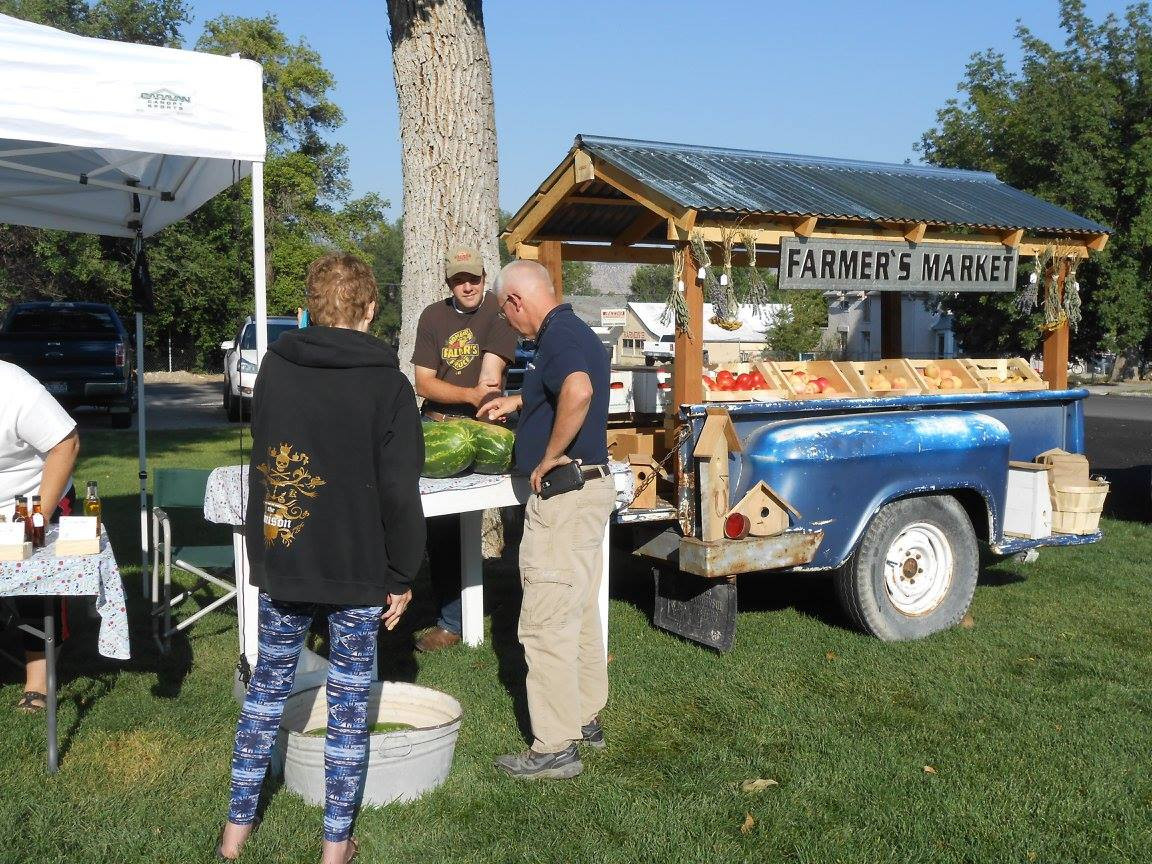
Twenty-five designated communities have established a Farmers Market as one of their Access to Healthy Food strategies.* Farmers Markets not only increase access to fresh fruits and vegetables and other locally sourced foods, but they support local businesses (including farmers!) and create a space for community connection.
Farmers Market Overview
“A farmers market is a multiple vendor farm-to-consumer retail operation, where producers sell goods at a set outdoor or indoor location. Markets are usually held once a week and vary in size from a few stalls to several city blocks. Most farmers markets are organized and operated by community organizations, public agencies, or public/private collaborations with volunteer support” (County Healthy Rankings & Roadmaps).
Farmers Markets are designated for local sellers, and to meet the USDA’s Food and Nutrition Services department’s definition, at least two vendors must sell agricultural products such as produce, meat/poultry, seafood, honey, plants, eggs, dairy, or grain. (Much more than two vendors need to sell SNAP-eligible food for your Market to accept SNAP, but we’ll get to that below!).
Farmers Markets are adaptable to your community sizes and needs. Whether you organize your Farmers Market as a place for local farmers to sell their produce, meat, and dairy, or you expand it to all local businesses and include community draws like live music, every city and town can benefit from a Farmers market.
Why is it important?
Farmers Markets offer three benefits to your city or town:
- Increase access to fresh, healthy, and local foods.
- Provides space for farmers to sell products directly to consumers, allowing them to retain more of the profit.
- Keeps consumer money in the community, strengthening your local economy.
1. Healthy food access
“Access to affordable, nutritious food is essential to the health and wellbeing of Utahns. Communities with limited access to healthy food experience higher rates of chronic disease, including type 2 diabetes and heart disease, as well as increased healthcare costs and decreased quality of life. Food environments shaped by income, geography, transportation, and affordability barriers disproportionately affect communities with limited access to healthy food, including low-income communities and older adults” (Utah Foundation, 2023).
Farmers Markets increase access to healthy and high-quality fresh food, especially in areas that lack access to stores that sell affordable healthy food. According to County Healthy Rankings, access to a variety of high-quality produce at lower prices than retailers is one of the most commonly reported reasons for shopping at Farmers Markets.
2. Supporting local farmers and strengthening community
Did you know American farmers only receive 15.9 cents on every dollar Americans spend on food? And that cent-per-dollar continues to decrease (it was 17.4 cents in 2017).
At Farmers Markets, American Farms can see up to 90 cents on the dollar for their product.
Providing a space for farm-to-consumer purchasing not only ensures community members get access to the freshest produce and agricultural products, but also that the farmers are properly compensated for their contribution. These venues also build relationships between local farmers and relationships between farmers and their local community. “Those relationships in turn build strong communities and resilient local food systems, giving farmers a source of income and consumers confidence in the food they are purchasing.” (HANDBOOK, CITE). Farmers Markets make space for rural farmers into the rapidly growing urban agriculture movement and bring more visibility to farmers’ products in rural areas.
“Wherever they are located, farmers markets bring the consumer and producer together in a celebration of local food, forging relationships that often endure many years. They offer fresh, locally produced food to meet the growing consumer demand, and in turn they support farms and small businesses, help to preserve agricultural heritage, and build community connections where people can trust the food they feed their families. Farmers markets bring together people of often vastly different backgrounds and demographics, strengthening our communities.” (HANDBOOK, CITE)
3. Support Your Local Economy
In 2015, Americans bought $1.5 billion worth of local, quality products directly from more than 150,000 farmers, ranchers, and agricultural entrepreneurs. Just like farmers retain more profit in direct-to-consumer sales, a series of case studies by Civic Economics showed that local selling venues like Farmers Markets keep 30-45 cents on the dollar in the local community versus 15 cents to the dollar when spent at a large chain. That’s twice the amount staying local if you buy local!
Even better, “Farmers Markets generate business, and business creates jobs” (Farmers Market Coalition CITE). If demand for direct-selling is high and farmers can retain that extra income, the need and means to employ more people increases. Farmers Markets also bring business to the local stores that participate in the Market and other businesses that are in the community.
Read more about local impact here: Where the Magic Happens: Farmers Markets as a Nexus of Community and Opportunity.
How do you do it?
One of the best resources on building and sustaining Farmers Markets is the Utah Farmers Market Network’s Market Manager Handbook, and they gave this summary on the most important things to identify when starting a Farmers Market:
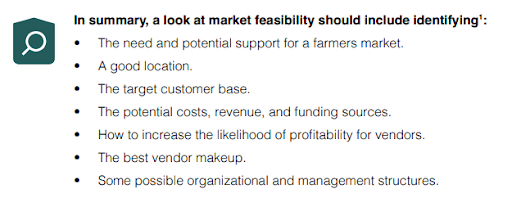
The next two questions are when and where.
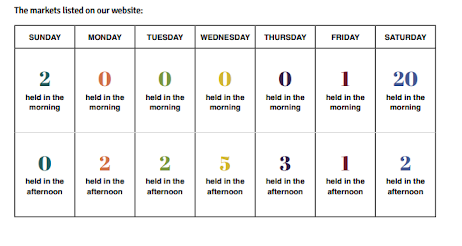
When: The when should be established based on local growing seasons so you can offer the freshest local produce. Often, this is between June-October every year. However, the time of day and day of week fluctuate between Utah communities, based on what your city or town will do best with. Here are some examples from the Utah Farmers Network Directory of the Farmers Market seasons, day of week, and the runtime:
- Bear Lake Valley: June-September, Fridays 3PM-7PM
- Bear River City: June-October, second Saturdays 10AM-2PM
- Bountiful: June-October, Thursdays 4PM-8PM
- Capitol Reef: May-October, Saturdays 3PM-5PM
- Ogden has a Summer, Fall, and Winter market.
- Winter: January-February, Saturdays from 10AM-2PM
- Summer: May-September, Saturdays 8AM-1PM
- Fall: September-October, Saturdays 9AM-2PM
- Highland: June-October, Thursdays 4PM-8PM
- Millcreek: July-September, Wednesdays 5PM-9PM; October, Fridays 5PM-8PM
- Sandy: June-October, Saturdays 9AM-1PM
- The Historic Monastery Farm (Huntsville): July-August, Saturdays 9AM-2PM
On page 18 of the Market Manager Handbook, they have a run-down of Utah Farmers Markets times and days or the week:
Where: City leaders can support the success of Farmers Markets through zoning that promotes Farmers Markets. Some things to think about, according to County Health Rankings:
- Locate your market in a central, accessible site and leverage public transportation to increase access.
- Operate in underinvested communities to offer community-tailored services.
On page 17 of the Market Manager Handbook, UFMN lays out a checklist of other things to think about when placing your Farmers Market:
- Is it accessible for and visible to both vendors and customers? The ideal space is flat and unobstructed. Think about
- Traffic flow
- Roadways
- Ease of locating booths and canopies
- Is there enough space to allow for operations and potential future growth?
- Is there ample parking for both vendors and customers?
- Is the site accessible and safe for vendor loading and unloading?
- What amenities are on site?
- Is there access to electricity, water, and restrooms?
- What about trash collection?
- Is there shade for vendors and customers?
- Who owns the space and how will you secure the use of it?
- Is it available and affordable?
- Think outside the box if city/government spaces are not available: a local landowner may be willing to allow use of a parcel of land, a local business owner, church, or civic organization may have a parking lot that isn't used during potential market hours.
- Is there a sense of place to the location?
- Are there tables and benches, places for people to meet, eat, and gather?
- Are there other features to the site that encourage people to come and shop?
- Does it lend itself to the image you want to create your market?
- Is there a need for a market in this location?
- Who are your potential customers and what do they want to buy?
- This helps you center your market to serve those who would most benefit
- Is the location near the target shoppers?
- Is it in a safe space?
When you are planning out your site, there are a couple other things to consider. For example, when sketching out stall size, reserve ~10’x25’ feet per stall (based on a 10’x10’ average canopy size) this allows vendor vehicles if needed. If there isn’t room for vendor vehicles, designate vendor parking and an unloading/loading zone. For best customer flow, rows between stalls should be a minimum 12’. Keep vendor booths side-by-side with no space to keep visitors going through the whole market instead of slipping between vendors. Plan a flow that’s natural and leads the consumers through the entire market in a circular pattern, avoiding “dead-ends.” Place flagship vendors at the entrances of the market and spread out vendors with similar items so they aren’t right next to each other. If your Farmers Market allows food trucks and prepared food vendors, put them more towards the middle with seating and shade. Your market information booth needs to be clearly marked, especially if you are a SNAP-accepting Market (Described in the How to set up SNAP at your local Farmers Market section below). Lastly, consider placing a map at the entrance(s) of the market that outlines general vendor types (try to put these together – arts and crafts, vegetables, poultry, etc.), restrooms, trash cans, and parking.
Now, onto the who. Who is going to run your market, make sure everything is done properly, that all the vendors get paid, that the street is picked up week, that outreach is going well? Welcome to Managing your farmers market.
Page 19 of the Market Manager Handbook has a list of questions you need to answer:
- Where will the farmers come from and how will you get them to participate?
- Is your location within a reasonable driving distance of local farms?
- What support systems do you have in place? Who are your potential financial donors or sponsors? Identifying these early on will help you get off to a good start.
- Are you planning to hire staff to run the market or will it be volunteer-run?
- Have you formed a steering committee or working group to get the plan in place? This should include both community stakeholders and farmers.
- Think about the structure of your market: are you creating a for-profit business model, a non-profit organization, or are you part of a local government agency?
- What is your governance structure? Will you have a board of directors?
- How will your market be managed?
- A beginning market may start out with a volunteer manager and a group of like-minded community members who all have a stake in the market's operations.
- Some markets support a part-time seasonal manager, others employee a full-time, year-round manager and a staff of seasonal helpers.
- Your management structure will depend on your financial support, and will likely evolve and change over time as your market grows and changes.
- What local businesses are in the area that could benefit from your market and be potential sponsors or partners? And, are there any who would not benefit and would see themselves in conflict with a market in their area?
- Identifying these early will help you to find ways of garnering support and perhaps forging new partnerships for mutual benefit.
- How will you get the word out? What kinds of advertising and media will you use to promote your market?
- Remember, if no one knows about your market, it will not succeed.
The Handbook also has several steps you need to go through to set up the behind-the-scenes of your market. Here’s the condensed version:
(a) Build Market Structure (Chapter 2, starting on page 22).
- Recruit people to help you
- This should include people for a steering committee, a volunteer base or potential staff members (depending on your market structure), potential vendors and potential sponsors/stakeholders, like:
- Local Chamber of Commerce and other businesses
- Food banks and nutrition programs
- Nonprofits
- Schools and universities
- Religious Groups
- This should include people for a steering committee, a volunteer base or potential staff members (depending on your market structure), potential vendors and potential sponsors/stakeholders, like:
- Define your mission statement
- What is the goal for starting your market? Is it to increase access to healthy food? Create community connection? Revitalize your local economy? All three? Write your mission statement around those goals.
- Examples of Utah Farmers Markets' missions statements can be found on page 23 of the handbook.
- Decide governance structure and management guidelines
- This can be informed by the people/businesses you recruit, but some of the options are:
- Informal or single proprietorship: a small number of individuals manage the whole market.
- Third party, or umbrella organization: If you are a part of your city's government and/or partnering with a local nonprofit or Chamber, this is probably where you will start. The legal structure of your department or the organization taking ownership of the Market will dictate the Market's structure and governance.
- Nonprofit, incorporated or unincorporated: A market with a tax-exempt status, where profits generated by the market are reinvested into the market and its programs. These types of markets are governed by a Board of Directors and managed by a board member or employee(s).
- For-profit corporations or LLC: a private business governed by a single "boss" that makes decisions and may or may not have a Board of Directors. Profits are held by the private business.
- Cooperative: Vendors and/or community members are included in the decision making process and share the responsibility. These are generally set up as a for-profit business.
- Here's the breakdown of Market types in Utah
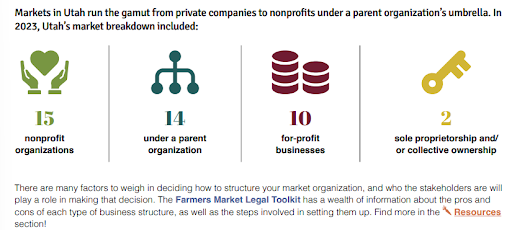
- Learn more at the Center for Agriculture & Food Systems Farmers Market Legal Toolkit
- This can be informed by the people/businesses you recruit, but some of the options are:
- Write by-laws
- If you are operating as an umbrella, nonprofit, or cooperative organization, you need to have by-laws (single-proprietorships and LLC businesses are not required to have these)
- By-laws include your organization's
- name and address
- purpose
- definition and powers of the Board of Director
- general meeting requirements (especially of the Board)
- defined process for amendments and record keeping.
(b) Create Your Management Documents (Chapter 2, starting on page 26)
- Operational guidelines that detail the specifics of the market. Here are some examples from the Handbook:
- Dates/days of the week and hours of operation
- Application deadlines and fees (if applicable), as well as rules for renewal and existing contracts
- How to contact the manager and the role that a Board of Directors or others play in managing the market
- Who can sell and what they can sell (e.g., producers only, vendors selling only what they grow, local only, no reselling of purchased produce, etc)
- The jury process or means by which vendors are chosen (be specific if rules and processes differ with vendor type)
- The preferred vendor mix - number of stalls for different types of vendors, such as crafts, farmers, food service, community groups, etc., and how individual vendor location is decided
- The right of the manager to inspect and monitor market operations and enforce the rules, including adjusting vendor locations as needed
- Responsibilities of staff as well as vendors
- Grievance process for dealing with disputes, including how rules will be enforced (verbal warming, written warning, fines, expulsion from the market)
- General customer/public management rules (e.g. whether dogs are allowed, whether political campaigns or religious groups are allowed, how customers can report issues, acceptable behavior, alcohol and firearm rules, whether smoking is allowed, solicitation outside vendor booths...)
- Limits to market liability and responsibility for unexpected changes (weather events, city construction, etc)
- Non-discrimination statement
- Ownership of your bran and logo and how it may be used
- Disaster preparedness and emergency management plan
- Market rules and contracts for vendors (discussed in Vendors section below!)
- Staff and volunteer management policies.
- If your Farmers Market is under a parent organization, that's a great place to start.
- Make sure you have:
- Job descriptions
- Employee rules
- Volunteer utilization and expectations
(c) Get Your Legal Paperwork in Order (page 30-32 of the Handbook!)
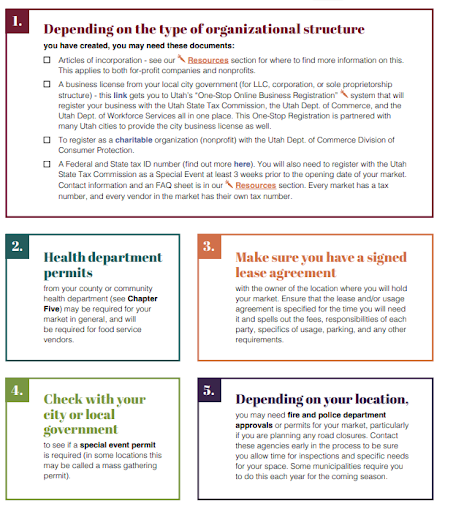
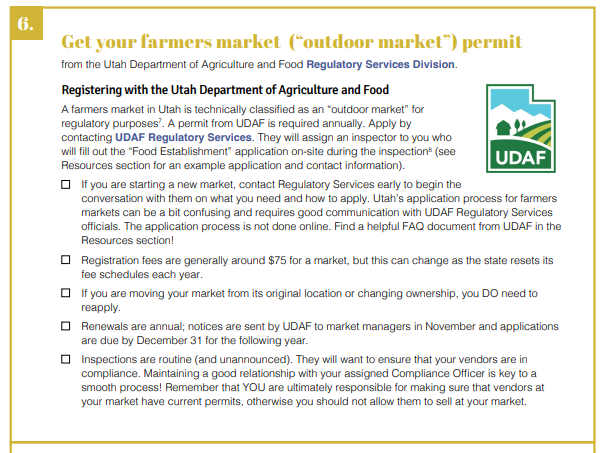
Managing your Farmers Market
Before we get into what should be sold at your Farmers Market, the ins-and-outs of your vendors, and setting up SNAP, let’s dive into tips about managing your Farmers Market. Best practice is having a Farmers Market Manager, who is the public face of the market and also makes sure everything is running smoothly. This includes:
- Market operations
- Vendor and volunteer/staff management
- Permits
- Set up/take down
- Promotion and marketing
Depending on the structure and size of your Market, the Market Manager can be a full-time, year-round position, clear down to a seasonal volunteer position. However your Market’s Manager job description pans out, here are some of the duties and responsibilities every Market Manager should be able to perform.
Day to Day
Market Managers prepare for the season by applying for/updating permits and insurances and coordinating necessary inspections. They will prepare the budget, in partnership with other staff/volunteers depending on your Market’s structure. Market Managers will map the market as we talked about above, gather equipment, and hire and train staff/volunteers. If applicable, they will also get authorized for SNAP and manage that program.
Market Managers also need to keep studious records. From the due dates and fees for your permits and insurances to vendor renewals and sponsorships to market data, having reliable data is critical for the day-to-day and long-term success of your Farmers Market. Just some records to keep:
- Vendor details
- Staff and volunteer records
- Market metrics and operational information
- SNAP details
- Expenses and budget details
- Supplies, equipment, and merchandize inventories
- Signage/marketing inventory and how it’s used
A big barrier to Farmers Market success is under-marketing. Community members don’t know where it is, when it is, how long it goes on for. A Market Manager should be adept at Public Relations and Marketing so they can represent the Market appropriately to diverse audiences, from the Board of Directors to stakeholders to vendors to the general consumer. Marketing/PR things to keep in mind:
- Press releases
- Posters, flyers, local ads, radio spots, interviews
- Calendar with special events and highlighted seasonal items
- Reports of success
- Up-to-date website
- Email list for newsletters and market information
- Email lists for vendors and other stakeholders
- Social media (x3 a week for the best chances at success)
- Branding and merchandising
- Special events and market programs
- Word-of-mouth marketing from your board and staff/volunteers
You can find “Marketing 101 - Josh Jones’ Top 5 Tips for Farmers Markets” on page 42 of the Market Manager Handbook!
Season to Season
On the opening Market Day, the Market Manager will supervise set up and take down, oversee signage and merchandising set up, monitor vendors, handle customer service, manage SNAP, collect market data, manage staff/volunteers, and ensure market safety. Here are some tips to get ahead:
- Have an equipment tub so all your small supplies (credit card machines, laptops, pencils, SNAP tokens, First Aid, flyers…)
- Have a “packing list” of what you need and where
- Have a folder (digital or paper) with important information like phone numbers, copies of permits, and passwords that you might need.
- Have a vendor map to mitigate booth disputes or help you fill in spaces when someone does not show up.
- To-do list with assigned staff/volunteers (including the Market Manager duties).
At the end of the season, stakeholders will often want reports. You will need to know the successes and failures so you can improve next year. Therefore, your Market Manager and supporting staff/volunteers will need to aggregate all your data, total up fees/expenses, send out end-of-season evaluation surveys (customers, vendors, and sponsors), and perform an equipment inventory. Also at the end of the season, ensure all final payments are paid and fees collected, send thank-yous to supporters and vendors, create summary marketing material (website, social media, newsletter), and celebrate the season with your staff/volunteers, vendors, sponsors, and other stakeholders.
Between Seasons
Now is the time to analyze the good and the bad of that year’s market and adjust next year’s plan. Compile reports and create an Annual Report to track growth, changes, and impact (this should speak to your mission statement! Are you doing what you set out to do?). Look at your vendor/sponsor fees and adjust as necessary, then start advertising for new vendors and sponsors. Hire and train new staff/volunteers, review and refine policies and procedures, assess market needs for equipment, updated marketing, etc. Then plan your next season, including special events, financial planning and budgeting, and strategic planning for the future (like a SWOT analysis).
What should be in a local Farmers Market?
You’ve got your market down - the when, where, who, and how have been answered. Now we’ll go through the what.
First and foremost, your market should be local. “Local” can be determined by your community’s needs, but more than 85% of Farmers Markets vendors travel fewer than 50 miles to sell at Farmers Markets, and more than half of farmers traveled less than 10 miles, according to USDA. For example, the USU Farmers Market defines local as 80 miles or less.
Smaller Farmers Markets often will only have local, raw products, which have different registrations and requirements:
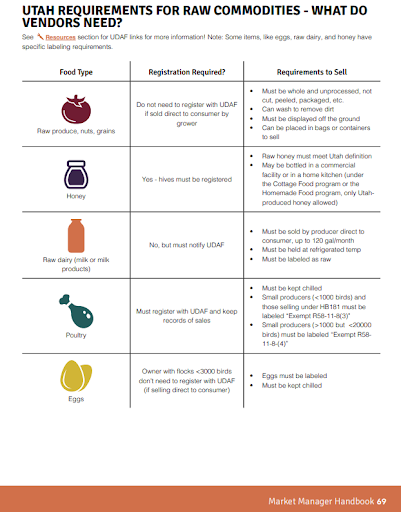
If you open your Farmers Market beyond raw, uncut produce, you need to register your Market with the Utah Department of Agriculture and Food (UDAF). See HERE for a list of UDAF regulations for Farmers Markets. The UDAF Q&A document also has a number that will start you down the right path.
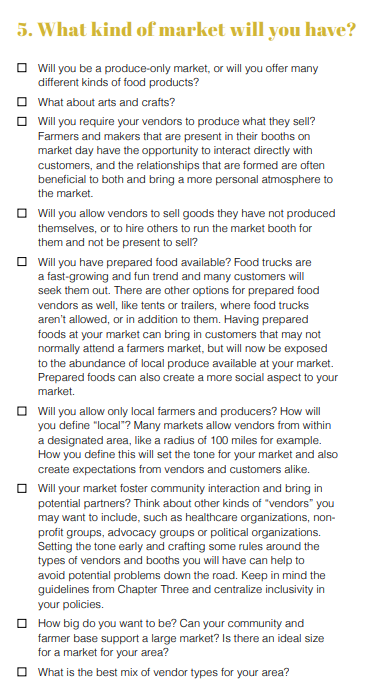
There are a lot of considerations beyond just “raw produce” or “more than raw produce” when deciding what to allow in your Farmers Market. Page 20 of the Market Manager Handbook has a list of questions to determine what kind of market you have, depending on what is allowed:
The USU Farmers Market created the following list of prohibited items to keep their market local and locally-made:
- Items grown, raised, or made outside 80 mile radius
- Carnival-type, high-sugar food (cotton candy, snow cones)
- Value-added foods and crafts not produced by the seller
- Private label, franchises, and multi-level marketing products
- Items with offensive or explicit languages or images
- Styrofoam packaging
- Thrifted items that have been upcycled and value-added are allowed, but not thrifted items themselves
- For example, a jacket embroidered with an original design is allowed, but not the jacket itself
When it comes to food regulations, vendors are responsible for their own permits and licenses, but you are responsible for ensuring they have the correct and up-to-date permits and licenses. The Market Manager Handbook gives a strong foundation of food regulations (Chapter 5) to help you determine if your vendors are in compliance, but to make sure, stay in contact with your state and local agencies. The best practice is to build a strong relationship with them so you can work together closely to ensure food regulations are followed and food is being safely sold. Some agencies you will work with for your Farmers Market include:
- County/local health department
- Utah Department of Agriculture and Food (UDAF)
- Regulatory Services Division
- Animal Industry Division
- Plant Industry Division
- U.S. Department of Agriculture (USDA)
- U.S. Food and Drug Administration (FDA)
We’ll go through some SNAP-eligible items you should have in your Farmers Market in the How to set up SNAP at your local Farmers Market section below.
Vendors
“Research suggests that including a wider variety of vendors is associated with increased sales” (County Healthy Rankings).
If you have the capacity, invite different types of vendors – raw produce, poultry, meat, dairy, arts and crafts – to join your Farmers Market to expand the appeal. When you are recruiting vendors, make sure you have an established set of market rules and a flushed-out vendor contract. Some things to consider according to page 28 of the Manager Market Handbook:
- Times for vendor load/take down
- Time to begin selling
- Fee structure, including how to pay and when
- Fees can be a flat seasonal or daily fee, a percentage of sales, a membership fee to the market, or a combination.
- Include information about fee reduction for those who volunteer or sponsor, if applicable.
- Most of the time a "one size fits all" fee approach won't work or be fair. You need to consider factors like the size of the stall, the needs of the vendor, what are they selling and their potential market share, how often they will be there, etc.
- Many markets charge more for arts and crafts or prepared food vendors and less for farmers who offer produce only.
- Be clear about any additional fees, such as late arrival fines or trash collecting fees
- Pricing rules (e.g. no "dumping" or lowering prices at the end of the day, a non-compete clause to keep vendors from undercutting others, posting of prices).
- Code of conduct for vendors
- Stress the importance of maintaining and fostering respect for other vendors as well as customers and managers.
- Be specific about prohibited behaviors (e.g. "hawking" or aggressive sales tactics, distributing leaflets, offensive or rude language, fraudulent practices) and how to report disputes or problems to management.
- Allowed signage and booth requirements (including sizes, canopy weights, hand-wash systems, electricity, parking, safety measures).
- Signs should have vendor names clearly visible, prices visible, product name or description, menus...
- Waste disposal and rules for keeping your space clean and free of hazards.
- Vendor requirements and responsibilities
- E.g, pre-season orientation meeting, reporting sales, accepting SNAP, end of season reporting, training their employees on market rules.
- How your market handles complaints, rules violations, and grievances
- Rules for having children and pets in booths
- What permits, licenses, and insurances are required for different vendors and how to submit them to market management, as well as how to display in booths.
- If you require a signed contract or vendor agreement, include details about where and when to submit.
- Rules for market vendors may vary depending on the type of vendor, and so your contracts for different types can vary as well
- Include a statement that makes clear that market management and staff are the ultimate authority for the market and can make changes at any time for any reasons to benefit the market, including the ability to remove a vendor from the market for any reason, with or without notice.
Licenses, Insurance, Permits
"First, have the vendor submit to you a copy of the local health department permit or the Department of Agriculture and Food Certificate of Registration. After receiving this, look at it closely to be sure it is current. If you have any questions at all, call us at 801-538-7124. You must keep this record available for inspection at the market" (UDAF). Send your vendors to the UDAF Farmers Markets Resources page, and look over the guidelines yourself, to make sure your market is fully compliant. But here are some quick tips:
- Vendors selling whole, uncut produce, are exempt from needing a permit
- Vendors selling food that was made in their homes should consult the Cottage Food Production Law and the Home Consumption and Homemade Food Act pages
- Vendors selling food that is prepared onsite must obtain all permits required
- If you are providing samples, you are also required to obtain permits.
The vendor also needs to always have a copy of their UDAF registration in their booth, within easy view of customers.
SNAP at your local Farmers Market
According to County Healthy Rankings, if Farmers Markets do not accept SNAP or EBT, that causes a barrier for community member use. So when you have the capacity, make this a priority for your Market.
Why is SNAP important?
When low-income families participate in the SNAP program, food insecurity is reduced by 17%. After six months, families with children saw a 33% decrease in food insecurity. Because it increases access to healthy food, participants also pay less in healthy care costs, especially related to hypertension and coronary heart disease.
How to set up SNAP at your local Farmers Market
The Utah Farmers Market Network has set up a page of resources for the Snap Double Up Food Bucks to introduce SNAP into your local food market (the webpage is linked in Resources below!).
Here's a quick rundown of the toolkit:
Why accept SNAP?
- SNAP increases financial stability and access to healthy food
- SNAP brings in new customers for your vendors
- SNAP stimulates the local economy
How does SNAP work?
Market customers buy SNAP tokens from the info booth with their EBT card. Those tokens can then be used to purchase eligible foods at the booth that day or at a later date. The money is deposited into the Market’s account, and the market manager reimburses vendors for the cash values of the tokens spent at their booths.
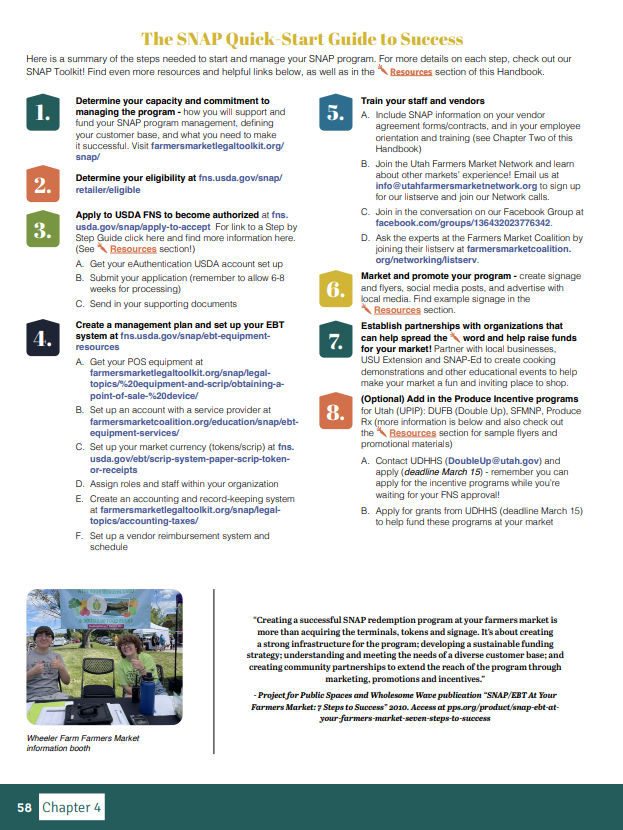
Seven Steps for Success
- Determine if your Market has capacity (staff time and budget for equipment and overhead)
- Find out if your market is eligible for SNAP
- Meet the Food and Nutrition Services definition of a Farmers Market (on page 6!)
- Meet the 50% rule (more than 50% of total retail sales must come from eligible staple foods) or the Staple Food Group Rule (continuously sell at least seven varieties of food within each of the four stable food groups)
- Become an authorized market
- The links in the toolkit are outdated. HERE is information on how to apply to accept SNAP from USDA.
- Get equipment and a service provider
- The links in the toolkit are outdated. HERE is a USDA grant program that connects Farmers Markets to app-based equipment for SNAP programs.
- Create a management plan
- Assign roles and responsibilities
- Set up your markets' SNAP tokens/currency
- Develop an accounting system
- Design a budget and fundraising plan
- The Utah Farmers Market Network has developed a sample budget for a SANP program, found HERE.
- Notify and train vendors
- Develop an outreach and marketing campaign
- Use promotional materials
- include SNAP in what you are already doing to promote your market
- Leverage strategic partnerships
SNAP-eligible food for Farmers Markets
Only specific foods can be purchased through SNAP funding, so it is important vendors do not sell ineligible items to SNAP customers. These are the four things you need to know, which the the Farmers Market Legal Toolkit goes into in depth.
- What food items are SNAP-eligible
- What CAN SNAP buy, and what it NOT buy? according to the USDA
- Utah's state-specific rules regarding SNAP-eligible food, according to the Department of Workforce Services
- Potential penalties if ineligible items are sold, and who is liable
- Potential penalties for SNAP rule violations.
The Marketing Manager Handbook gives a quick-start guide for SNAP at your Farmers Market.
Why Focus on Healthy Food Access?
Access to affordable, nutritious food is essential to the health and wellbeing of Utahns. Communities with limited access to healthy food experience higher rates of chronic disease, including type 2 diabetes and heart disease, as well as increased healthcare costs and decreased quality of life. Food environments shaped by income, geography, transportation, and affordability barriers disproportionately affect communities with limited access to healthy food, including low-income communities and older adults.
Utah cities and towns play an important role in shaping local food environments through policies, programs, land use decisions, and partnerships. However, many municipalities report limited funding, expertise, and support to address healthy food access effectively.
Resources
*These are designated communities of varying populations that have successfully implemented a community garden. Reach out to them to see if they can share their tips and tricks:
Examples of Vendors Guidelines:
Utah Farmers Market Manager Handbook
- In-depth how-to for all aspects of starting and maintaining a farmers market, with success stories and added resources included.
- Provides a directory of Utah Farmers Markets, resources for including SNAP in your Farmers Market, and the Utah Farmers Market Manager Handbook
-
National directory of Farmers Markets; find a successful Farmers Market near you and gain insight into locations, times, payment types, etc.
Utahns Against Hunger: Farmers Market Outreach
-
UAH works to increase access to fresh, healthy local food by supporting and promoting farmers markets that accept SNAP. Contact them for more information and support.
UDAF Regulations for Farmers Markets
- List of services and industries UDAF oversees. At the bottom is a guide if you’re not sure which Regulatory Program applies to your specific Market.
-
Answers questions about Market and vendor registration, including when it does/does not apply and who to call.
Farmers Market Coalition, "What is a farmers market?"
-
FMC outlines the what and why of starting and maintaining a farmers market in your city or town, including the benefits for your local economy and supporting local farmers.
Farmers Markets Impact on Local Economics
- American Farmland Trust blogpost about how Farmers Markets support the local economy
Center for Agriculture & Food Systems Farmers Market Legal Toolkit
- Important insights on how to structure your Farmers Market, from a business point of view
- Information on the SNAP Double Up Food Bucks program and how you can get it started.
- USDA's webpage about SNAP to use with Farmers Market marketing
Farmers Markets Accepting SNAP Benefits | Food and Nutrition Service
-
"Food and Nutrition Services: Use your SNAP benefits at your local farmers’ market" video to use for marketing
Food and Nutrition Service Farmers Market Programs
- FNS's resource page for Farmers Markets
Utah Farmers Market SNAP toolkit
- In-depth guide for setting-up and running a SNAP program at your Farmers Market
- List of SNAP-eligible items from USDA
Is your city or town on the path to being a Healthy Utah Community?
Reach out to our program coordinator, Emma, to learn more about the designation and get guidance on the application process: